

 English
 русский
 Español
The Modest Core: Four Views on Automotive Springs
Industry News-Automotive suspension systems rely on a component often overlooked in its simplicity: the spring. While advanced electronics and composite materials garner attention, the steel spring remains a fundamental element in vehicle dynamics, ride quality, and structural integrity. Its function is straightforward—to absorb energy and release it—but its design, manufacturing, and application involve a complex balance of physics, material science, and engineering constraints.
Material Selection and the Metallurgical Foundation
The performance of any automotive parts spring begins at the molecular level. The choice of material dictates the component's fatigue life, weight, and ability to withstand the cyclic stresses of daily operation. Many modern automotive springs are fabricated from high-carbon steel alloys, such as SAE 9254 or SUP12, which are chosen for their high yield strength and ability to undergo significant elastic deformation without permanent set. The manufacturing process further refines these properties; for instance, hot winding is typically used for large, heavy-duty coil springs in trucks, while cold winding is preferred for smaller, precision springs in passenger vehicles due to surface finish and dimensional accuracy.
Post-forming heat treatment is a critical phase that determines the spring's final mechanical properties. Through processes like quenching and tempering, the steel achieves a tempered martensitic structure, which offers the necessary hardness to resist permanent deformation and the toughness to withstand impact loads. Surface treatment also plays a decisive role. Shot peening, a process where small steel spheres bombard the spring's surface, induces compressive residual stresses. This step is essential for preventing fatigue cracks, which typically initiate at the surface under repetitive loading. Without this metallurgical foundation, a spring would succumb to failure within a fraction of its intended service life, regardless of its geometric design.
Geometric Diversity and Functional Classification
Automotive applications require different spring geometries because they serve distinct mechanical functions. The three primary types found in modern vehicles are coil springs, leaf springs, and torsion bars, each offering unique packaging and performance characteristics.
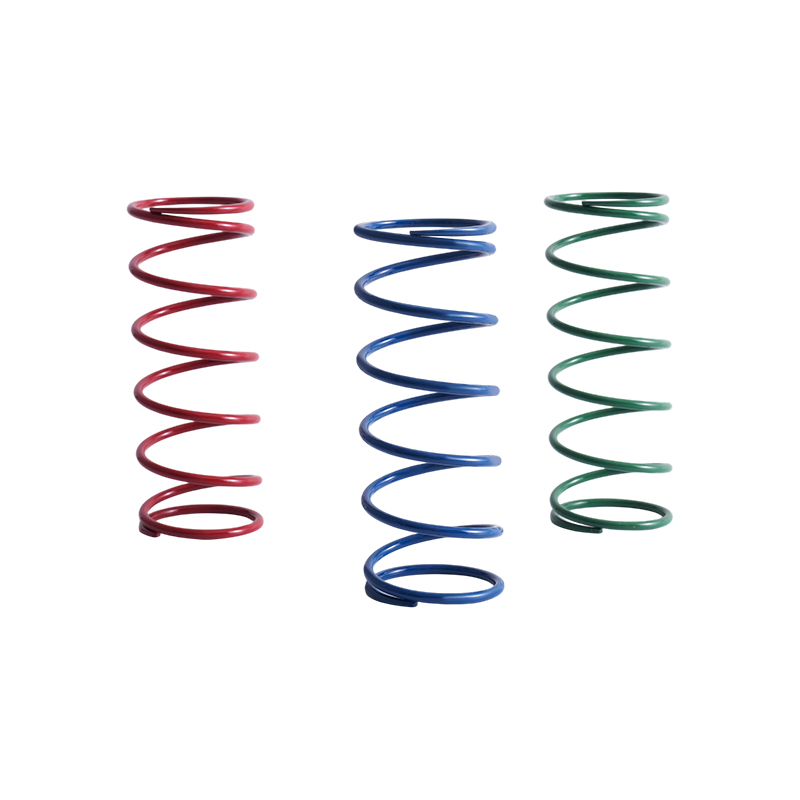
Coil springs are the prevalent in contemporary passenger cars. Their design parameters—wire diameter, coil diameter, pitch, and number of active coils—are calculated to achieve a specific spring rate, measured in newtons per millimeter. A linear-rate coil spring provides consistent resistance throughout its compression, while progressive-rate springs, where the coils are spaced unevenly, offer a softer initial travel for comfort and a stiffer final travel to prevent bottoming out during hard cornering or heavy loads.
Leaf springs, once universal, are now largely confined to heavy-duty trucks, vans, and solid-axle off-road vehicles. Their construction consists of several steel layers (leaves) of varying lengths bound together. This design provides inherent friction damping—a property that reduces oscillation but can also introduce stiction that degrades ride quality. Their advantage lies in their simplicity and load-bearing capacity, as they act as both a spring and a locating link for the axle, simplifying the overall suspension architecture.
Torsion bars represent a third geometry, functioning as a straight bar fixed at one end to the vehicle's frame and at the other to a suspension arm. Instead of compressing, they twist to provide resistance. This design is valued for its packaging efficiency, as it occupies less vertical space than a coil spring, making it suitable for vehicles where ground clearance or chassis layout is constrained.
Manufacturing Precision and Quality Control
The transition from raw steel to a finished spring involves a series of manufacturing steps where precision directly correlates with safety and longevity. For coil springs, the process begins with wire decoiling, followed by CNC-controlled winding that ensures consistent geometric tolerances. After winding, springs undergo stress relief to eliminate residual stresses introduced during forming. Subsequently, they are heat-treated, shot-peened, and often subjected to a process called “scragging”—a pre-compression that induces a beneficial set, stabilizing the spring's free height and ensuring that its performance characteristics do not change after initial installation.
Quality control throughout this process is systematic rather than sporadic. Manufacturers employ several non-destructive testing methods:
Eddy current testing: Used to detect surface flaws on the wire before forming, identifying seams or cracks that could become failure points.
Load testing: Automated systems compress each spring to a specified height, measuring its spring rate and ensuring it falls within a narrow tolerance window, often less than ±3% of the nominal value.
Corrosion resistance verification: Coating processes, such as epoxy powder coating or cathodic electro-deposition, are tested for adhesion and thickness, as corrosion pits act as stress concentrators that accelerate fatigue failure in service.
These controls are not merely for quality assurance but are a fundamental requirement, given that a single defective spring can compromise vehicle stability, particularly in scenarios involving emergency maneuvers or uneven road surfaces.
Performance Dynamics and System Integration
A spring does not function in isolation; its behavior is inextricably linked with the damper (shock absorber) and other suspension components. The spring's primary role is to support the vehicle's static weight and absorb road irregularities, while the damper dissipates the kinetic energy stored in the spring to prevent prolonged oscillation. The relationship between spring rate and damping coefficient is a critical engineering calculation. A spring that is too stiff for its paired damper will result in a harsh ride and reduced tire contact with the road, while an overly soft spring can lead to excessive body roll and poor handling response.
Modern vehicle development has also introduced adaptive and semi-active systems, but the mechanical spring remains the base component. In these systems, the spring provides the fundamental suspension frequency, which typically falls between 1.0 and 1.5 Hz for passenger cars to avoid inducing motion sickness in occupants. Engineers also consider the concept of “unsprung mass”—the mass of components not supported by the springs, including wheels, brakes, and suspension links. Reducing the weight of springs themselves contributes to lower unsprung mass, which allows the suspension to respond more quickly to road inputs, maintaining tire contact more effectively.
Related products
If you are interested in our products, please consult us
CONTACT DETAIL
- Email: helispring@163.com
- Tel: +86-18767775615
- Address: Jinlu Industrial Zone, Beibaixiang Town, Yueqing, Wenzhou City, Zhejiang Province, China.
PRODUCTS
MOBILE TEMERNAL
Wenzhou Heli Spring Manufacturing Co., Ltd. ALL RIGHTS RESERVED.

China Customized Spring Manufacturer