

 English
 русский
 Español
Operational Parameters and Environmental Performance of Coil Springs
Industry News-Load Compatibility and Spring Rate Selection
Selecting a coiled helical spring with an appropriate spring rate is a primary consideration. The spring rate, expressed in newtons per millimeter (N/mm), determines how much force is required to compress the spring by a given distance. When this rate does not align with the vehicle's gross vehicle weight rating (GVWR), several consequences emerge. An under-rated spring causes excessive sag, reducing ground clearance and altering suspension geometry, which negatively affects camber and toe angles. Conversely, an over-rated spring reduces suspension travel, leading to a stiff ride and diminished tire contact with uneven surfaces. Manufacturers specify spring rates based on axle loads, and aftermarket replacements must match these specifications precisely. Additionally, progressive-rate springs, where coil spacing varies, offer variable resistance but require careful pairing with dampers to avoid mismatched compression and rebound characteristics.
Fatigue Life and Material Degradation
Coiled helical springs operate under cyclic loading conditions, and their service life is defined by fatigue resistance. Each compression cycle induces tensile stresses along the inner diameter of the coil, where cracks typically initiate. Factors that accelerate fatigue include surface defects, inclusions in the steel, and inadequate shot peening. Shot peening induces compressive residual stress at the surface, which counters tensile stresses during operation. When this surface layer is compromised—through corrosion, stone impacts, or improper handling during installation—fatigue life diminishes significantly. Operators should inspect springs for visible pitting or coating damage at regular intervals, as failure tends to occur without extensive prior deformation. A spring that loses more than 5 percent of its free height due to permanent set should be replaced, as its load-bearing capacity has been permanently altered.
Corrosion Protection and Coating Integrity
The operating environment exposes coil springs to moisture, road salts, and debris. Protective coatings serve as the primary barrier against corrosion, which acts as a stress concentrator that reduces fatigue strength. Common coating systems include epoxy powder coating, cathodic electrodeposition, and zinc phosphating with a topcoat. Each system provides a different level of protection; epoxy coatings offer mechanical abrasion resistance but can chip when struck by road debris. Once the coating is breached, corrosion initiates at the exposed steel surface. In regions where de-icing salts are used, electrochemical corrosion accelerates, and rust pits can reduce the spring's effective cross-sectional area by 10 to 15 percent before visible failure occurs. Regular underbody washing to remove salt residue and periodic visual inspection for coating damage are practical measures to extend service life.
Installation and Suspension Geometry Alignment
Improper installation of coil springs affects vehicle dynamics beyond ride comfort. Coil springs are typically seated in upper and lower isolators made of rubber or polyurethane. These isolators reduce noise transmission and allow rotational movement during compression. If a spring is not correctly seated in its perches, it can bow under load, causing uneven stress distribution and premature failure. Furthermore, when springs are replaced, associated suspension components such as strut mounts, bump stops, and dampers should be assessed. A new spring paired with a worn damper results in uncontrolled oscillation, as the damper's damping coefficient is no longer matched to the spring's energy release rate. Alignment parameters also shift after spring replacement due to changes in ride height, necessitating a four-wheel alignment to restore manufacturer specifications.
Considerations for Coil Spring Use
|
Consideration |
Factor |
Consequence of Neglect |
|
Load Compatibility |
Spring rate matching GVWR |
Sagging, altered geometry, reduced handling |
|
Fatigue Life |
Surface integrity and shot peening |
Unexpected fracture, loss of ride height |
|
Corrosion Protection |
Coating integrity and material |
Stress corrosion cracking, reduced cross-section |
|
Installation |
Seating, isolators, alignment |
Noise, uneven wear, misalignment, damper mismatch |
Material Behavior at Sub-Zero Temperatures
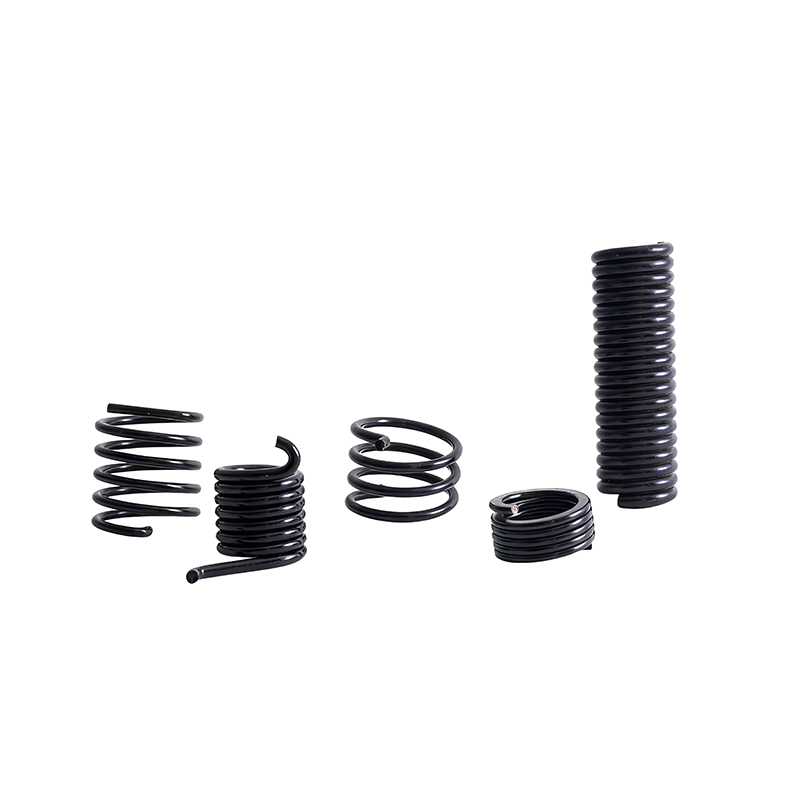
Coiled helical springs manufactured from standard high-carbon spring steels, such as SAE 9254, exhibit changes in mechanical properties when exposed to low temperatures. As ambient temperature drops below -20°C, the steel's yield strength increases marginally, but its fracture toughness decreases. This shift means that while the spring can support static loads without issue, its ability to withstand impact loads—such as striking a pothole or traversing a frozen rut—is reduced. Brittle fracture becomes a concern if pre-existing surface defects or microcracks are present. Manufacturers typically specify a service temperature range for standard spring steels, and vehicles operating in regions where temperatures fall below -30°C may require springs made from low-alloy steels with improved low-temperature toughness.
Salt-Induced Corrosion and Stress Corrosion Cracking
In cold climates, road de-icing agents—primarily sodium chloride, calcium chloride, and magnesium chloride—accelerate corrosion. Coil springs are particularly vulnerable because they undergo continuous flexing. When a spring compresses, its coating may flex, and micro-cracks in the coating allow chloride-laden water to reach the steel surface. The combination of tensile stress (present on the spring's inner diameter during compression) and a corrosive electrolyte creates conditions for stress corrosion cracking (SCC). Unlike uniform corrosion, SCC propagates rapidly and can lead to sudden fracture without prior plastic deformation. Studies have shown that springs in regions with frequent winter salting have a service life reduction of 20 to 40 percent compared to those in dry, salt-free environments unless additional protective measures such as heavier coating thicknesses or sacrificial zinc layers are applied.
Accumulation of Ice and Operational Interference
Mechanical interference from ice accumulation presents a distinct operational issue. In vehicles with close packaging between the spring and other suspension components—such as strut-type front suspensions—ice can build up on the spring coils and surrounding structures during freeze-thaw cycles. This ice accumulation can physically restrict spring travel, causing the spring to become effectively stiffer or, in severe cases, preventing full rebound. When a spring cannot extend fully, the suspension may remain partially compressed, altering ride height and reducing wheel articulation. In such conditions, the damper may also experience off-axis loads due to constrained spring movement, leading to premature damper seal wear. Operators in regions with freezing rain or slush should inspect suspension areas for ice bridging, particularly after extended driving in wet, near-freezing conditions.
Hot Climate and Arid Environment Performance
Thermal Softening and Spring Rate Stability
Coiled helical springs rely on the shear modulus of steel, which remains relatively stable across the typical operating temperature range of -40°C to 80°C. However, when springs are subjected to sustained high temperatures—such as those found in desert environments where pavement temperatures exceed 60°C, combined with heat generated from braking and exhaust systems—the material's modulus decreases marginally. For standard spring steels, the reduction in shear modulus between 20°C and 100°C is approximately 2 to 4 percent. While this change is small, it can affect ride height and spring rate consistency in vehicles operating at load. More significant is the effect on coating durability. Epoxy-based coatings degrade more rapidly under prolonged UV exposure and elevated temperatures, losing adhesion and becoming brittle, which compromises corrosion protection.
Accelerated Coating Degradation and Corrosion Risk
Contrary to the assumption that arid environments eliminate corrosion risk, hot and dry conditions present a different set of challenges. Ultraviolet radiation degrades organic coatings through a process known as photodegradation, causing chalking, cracking, and loss of adhesion. Once the coating is compromised, airborne dust—which may contain chlorides or sulfates in agricultural or coastal desert regions—settles into the exposed steel surface. Additionally, condensation that occurs during nighttime temperature drops can provide sufficient moisture to initiate corrosion. In regions where roads are treated with dust suppressants, chemical residues can accumulate on suspension components. Without the frequent rainfall that naturally washes away corrosive deposits in temperate climates, these residues concentrate over time, leading to localized corrosion that is often more aggressive than in regions with consistent precipitation.
Increased Cyclic Loading from Road Surface Conditions
Hot climates often correlate with road surface characteristics that affect spring duty cycles. Asphalt pavement in high-temperature regions experiences deformation under heavy vehicle loads, creating ruts and uneven surfaces. Similarly, unpaved roads in arid areas present continuous small-amplitude, high-frequency inputs. Coiled helical springs subjected to such conditions experience an increased number of compression cycles per kilometer compared to vehicles operating on smooth, paved highways. This higher cycle count accelerates fatigue accumulation. Furthermore, the combination of elevated ambient temperatures and increased cyclic loading reduces the margin between operating stresses and the material's fatigue limit. In such operating environments, springs with shot-peened surfaces and thicker coating systems demonstrate measurably longer service intervals. Regular inspection intervals should be shortened when vehicles are consistently operated on unpaved roads or in high-temperature, high-dust conditions.
Related products
If you are interested in our products, please consult us
CONTACT DETAIL
- Email: helispring@163.com
- Tel: +86-18767775615
- Address: Jinlu Industrial Zone, Beibaixiang Town, Yueqing, Wenzhou City, Zhejiang Province, China.
PRODUCTS
MOBILE TEMERNAL
Wenzhou Heli Spring Manufacturing Co., Ltd. ALL RIGHTS RESERVED.

China Customized Spring Manufacturer