

 English
 русский
 Español
Automotive Compression Spring Selection
Industry News-How Compression Springs Function in Vehicle Systems
Automotive compression springs store mechanical energy when compressed and release it when the load is removed. They are most visible in suspension systems (coil springs around shock absorbers), but also appear in valve trains (inside engines to close valves), clutch assemblies, brake systems (return springs), and seat mechanisms.
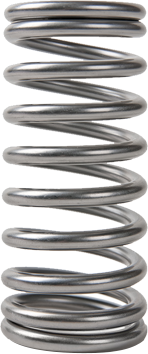
The spring's behaviour follows Hooke's Law: the force required to compress the spring increases linearly with the distance compressed, up to the spring's elastic limit. For a typical automotive coil spring, the spring constant (stiffness) ranges from 20 to 200 N/mm, meaning that a 100 mm compression requires 2,000 to 20,000 N of force. The spring must return to its original length after each compression cycle; over millions of cycles, gradual settling (called "spring sag") reduces the free length by 2-5 percent, which lowers the vehicle's ride height by a corresponding amount.
Common Spring Materials and Their Limitations
The vast majority of automotive compression springs are made from oil-tempered carbon steel wire, specifically SAE 9254 (silicon-chromium steel) or SAE 9260 (silicon-manganese steel). SAE 9254 contains 0.51-0.59 percent carbon, 1.20-1.60 percent silicon, 0.60-0.80 percent chromium, and 0.60-0.80 percent manganese. Its tensile strength ranges from 1,600 to 1,900 MPa for wire diameters of 10-16 mm (typical for suspension springs). SAE 9260 has 0.56-0.64 percent carbon, 1.80-2.20 percent silicon, and 0.75-1.00 per cent manganese; it has slightly lower tensile strength (1,500-1,800 MPa) but better impact resistance. Both materials are shot-peened after forming—a process where small steel balls (0.5-1.0 mm diameter) are blasted at the spring surface to create compressive residual stresses. Shot-peening increases fatigue life from 100,000 cycles to over 500,000 cycles by delaying crack initiation at the surface. Stainless steel springs (type 302 or 316) are used only in corrosive environments (e.g., brake calliper return springs) where carbon steel would rust; they have lower tensile strength (1,200-1,400 MPa) and cost 3-5 times more.
Mechanical Limits and Failure Modes
Compression springs fail in two primary ways: fatigue fracture (cracking after many cycles) or sagging (permanent length reduction). Fatigue fractures typically initiate at a surface defect—a scratch, inclusion, or corrosion pit—where stress concentration exceeds the material's endurance limit. The endurance limit for shot-peened SAE 9254 at 10⁷ cycles is approximately 600-700 MPa, about 40 percent of the ultimate tensile strength. A spring cycled beyond this stress level will eventually crack. Sagging occurs when the spring is stressed beyond its elastic limit (0.3-0.4 percent offset yield strength), causing plastic deformation of the wire. A spring that has sagged by 5 mm will not return to its original length when unloaded; this reduces preload on the suspension or valve system. Sag is more common in springs that have been overloaded (e.g., a vehicle carrying weight beyond its gross vehicle weight rating) or that have been subjected to high temperatures (above 120°C for carbon steel, which accelerates stress relaxation). For engine valve springs, operating temperatures of 100-150°C reduce sag resistance significantly; high-performance engines use chrome-silicon steel (SAE 9254V, with vanadium) that maintains 90 percent of its initial strength at 200°C.
Selection Criteria for Automotive Compression Springs
Vehicle Suspension and Ride Height Requirements
The spring's free length and installed height determine the vehicle's ride height. The installed height is the length of the spring when compressed by the weight of the vehicle (called the "curb load"). The difference between free length and installed height is the "preload compression." For a typical passenger car, preload compression is 30-60 mm, meaning a spring with 350 mm free length is compressed to 290-320 mm when the car is sitting on its wheels. To achieve a specific ride height, measure the existing spring's free length and installed height, then select a replacement spring with matching dimensions within ±5 mm. Changing the free length by 10 mm alters ride height by approximately 10 mm (a 1:1 ratio for most suspension designs, because the spring's motion ratio is close to 1.0 for strut-type suspensions). For vehicles with a motion ratio of 0.6-0.8 (common on double-wishbone suspensions), a 10 mm change in spring free length changes ride height by only 6-8 mm. Consult the vehicle's factory service manual for the correct motion ratio.
The spring rate (stiffness) directly affects ride quality and body roll. A higher spring rate reduces body roll during cornering but makes the ride firmer (transmits more road imperfections to the cabin). For a typical family sedan, spring rates are 30-50 N/mm at the front and 40-60 N/mm at the rear. For a sport-oriented vehicle, rates increase to 60-100 N/mm. To calculate the required spring rate for a given vehicle weight and desired suspension frequency, use the formula: rate (N/mm) = (sprung mass per corner in kg × (2π × frequency in Hz)²) / (motion ratio² × 1,000). A typical suspension frequency for passenger cars is 1.0-1.3 Hz; for sports cars, 1.5-2.2 Hz. Increasing the spring rate by 20 percent raises the suspension frequency by approximately 10 percent (since frequency is proportional to the square root of spring rate). Changing only one spring (e.g., only the left front) without matching the other side is not recommended; differences in spring rate of more than 10 percent between left and right cause the vehicle to lean to one side under load and may affect steering.
Related products
If you are interested in our products, please consult us
CONTACT DETAIL
- Email: helispring@163.com
- Tel: +86-18767775615
- Address: Jinlu Industrial Zone, Beibaixiang Town, Yueqing, Wenzhou City, Zhejiang Province, China.
PRODUCTS
MOBILE TEMERNAL
Wenzhou Heli Spring Manufacturing Co., Ltd. ALL RIGHTS RESERVED.

China Customized Spring Manufacturer