

 English
 русский
 Español
1/4 Compression Springs: Materials, and Safe Use
Industry News-Common Types of 1/4 Compression Springs in the Market
A 1/4 compression spring refers to a helical spring with a nominal outer diameter (OD) of 1/4 inch (6.35 mm). However, note that "1/4" often refers to the OD, but sometimes to the inner diameter (ID) or the wire diameter. Always check the specification. These small springs are used in ballpoint pens, small switches, appliance buttons, valve mechanisms, toys, and medical devices. The following types are distinguished by wire diameter, end style, and load rating.
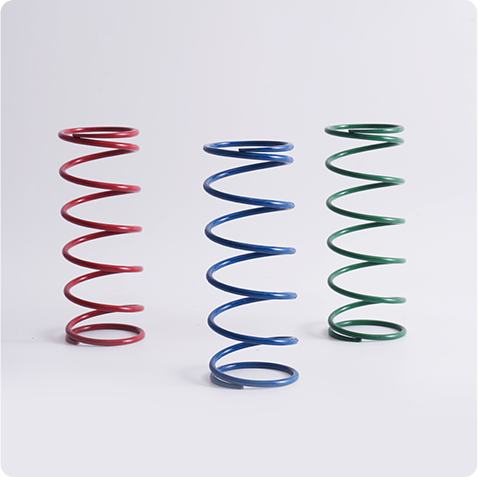
Standard 1/4 OD with music wire (0.020–0.048 inch wire). Most common. Outer diameter fixed at 6.35 mm (0.250 inch). Wire diameters: 0.020" (light), 0.030" (medium), 0.038" (heavy), 0.048" (extra heavy). Spring rates range from 0.5 N/mm (0.020" wire, 10 coils) to 25 N/mm (0.048" wire, 4 coils). Free lengths: 0.5 to 3 inches. Closed and ground ends are standard. Used for general-purpose compression where space is cramped. Industry code numbers like "LC-xxx" or "C-xxx" from manufacturers (Lee Spring, Century Spring) follow this pattern.
1/4 ID compression springs (for sliding over a rod or guide pin). Here, the inner diameter is 6.35 mm, so the OD is larger (typically 8–10 mm depending on wire diameter). These are used where the spring must wrap around a 1/4 inch shaft or bolt. Wire diameters: 0.028–0.062". Common in automotive linkage springs, firearm trigger springs, and machinery detent springs. The spring sits over a hardened steel pin (often 6.35 mm diameter) to prevent buckling.
Small 1/4 OD with very fine wire (0.010–0.018 inch). For extremely low forces (0.1–0.5 N/mm). Free lengths: 0.25 to 1 inch. Used in tactile switches, membrane button assemblies, and delicate instruments. The coils are so fine that the spring looks like a thin metal tube. These springs are easily damaged by over-compression (one overload can collapse them permanently). Often made from music wire or beryllium copper.
Conical (tapered) 1/4 compression springs. The OD tapers from 1/4 inch at the bottom to 3/16 or 1/8 inch at the top. When compressed, the small coils nest inside the larger coils, allowing the spring to compress to a very short solid height (often 30–40% of free length). Used in battery contacts, telescopic mechanisms, and pens where limited space exists. The spring rate is not constant—it increases as the spring compresses because the number of active coils decreases.
1/4 Compression Spring Material Information
Music Wire (ASTM A228) – the default choice. Music wire is high-carbon steel (0.70–1.00% carbon, 0.60–1.00% manganese, trace silicon) drawn through diamond dies to achieve high tensile strength. For 1/4 OD springs with 0.030" wire, tensile strength is 2,200–2,400 MPa (320–350 ksi). The wire has a smooth, polished surface (shiny gray) from the drawing process. Music wire is the most common material for general-purpose 1/4 compression springs because of its low cost and high strength. However, it rusts readily. A music wire spring in a humid indoor environment (60% RH, 25°C) will show visible surface rust after 6–12 months if not coated. In an outdoor application (rain, morning dew), rust appears within 2–4 weeks, and the spring may fail (break) in 6–12 months due to corrosion fatigue. For applications where rust is unacceptable (medical, food, outdoor), do not use music wire even if it is "zinc-plated." Zinc plating (electrogalvanized, 5–12 µm thick) on music wire springs delays rust but wears off at points of coil contact (where the spring touches itself). After 50,000 compression cycles, the zinc at the contact points is gone, and rust begins.
Chrome-Silicon Steel (ASTM A401) – for high fatigue life. Chrome-silicon steel contains 0.50–0.70% carbon, 0.60–0.90% chromium, and 1.80–2.20% silicon. The silicon acts as a deoxidizer and strengthens the steel by solid solution. For 1/4 OD springs (0.030–0.048" wire), tensile strength is 1,900–2,100 MPa—slightly lower than music wire, but the fatigue life is 3–5 times longer at the same stress. Chrome-silicon springs also tolerate higher temperatures (max 220°C vs. 120°C for music wire). They are less susceptible to sag (stress relaxation) when held compressed for long periods. A chrome-silicon spring compressed to 80% of its solid height for 1 year at 100°C loses 5–8% of its free length; a music wire spring under the same conditions loses 15–25%. Chrome-silicon is the material for automotive valve springs and high-cycle industrial mechanisms. The surface is typically a dark gray (from shot peening, which improves fatigue life). Cost: about 50–100% higher than music wire.
Stainless Steel (ASTM A313, Types 302, 304, 316) – for corrosion resistance. Stainless springs are made from austenitic stainless steel wire. Tensile strength for 0.030" wire is 1,600–1,800 MPa (lower than music wire by 30–35%). Consequently, for the same spring dimensions, a stainless spring has about 20–30% lower spring rate and lower maximum load capacity before permanent set. For many low-force applications (buttons, latches), this is acceptable. The spring rate can be increased by using a thicker wire or fewer coils. Type 302 is the most common for springs. Type 304 is slightly softer but more formable. Type 316 contains 2–3% molybdenum, which improves resistance to chlorides (seawater, salt spray). A 316 stainless 1/4 compression spring will show no rust after 2 years in a marine environment; a 302 spring may show minor pitting. All stainless springs should be passivated after manufacturing (nitric or citric acid bath) to remove free iron from the surface. Without passivation, a "stainless" spring can rust at the ends where wire cutters left iron residue. Cost: 3–5 times music wire.
Phosphor Bronze (ASTM B159) – for electrical and mild corrosion. Phosphor bronze (copper with 5% tin, 0.2% phosphorus) is not as strong as steel. Tensile strength for 0.030" wire is 700–1,000 MPa. Spring rate is about 40% of music wire for the same dimensions. It is used where the spring must conduct electricity (battery contacts, relay springs) or where the environment is moderately corrosive but not severe enough to require stainless steel (some chemical plants, fresh water). Phosphor bronze does not spark (safe for explosive environments). It also resists galling (sticking) when sliding against other metals. The color is golden yellow. Phosphor bronze is work-hardening; a spring that is overstressed (compressed beyond its elastic limit) will not return to shape but will not crack—it simply stays bent. Cost: about twice the music wire.
Related products
If you are interested in our products, please consult us
CONTACT DETAIL
- Email: helispring@163.com
- Tel: +86-18767775615
- Address: Jinlu Industrial Zone, Beibaixiang Town, Yueqing, Wenzhou City, Zhejiang Province, China.
PRODUCTS
MOBILE TEMERNAL
Wenzhou Heli Spring Manufacturing Co., Ltd. ALL RIGHTS RESERVED.

China Customized Spring Manufacturer