

 English
 русский
 Español
How is the spring rate of a helical spring calculated
Industry News-What factors affect it?
Spring rate (k) is the amount of force required to compress or extend the spring by a unit distance, measured in N/mm or lb/in.
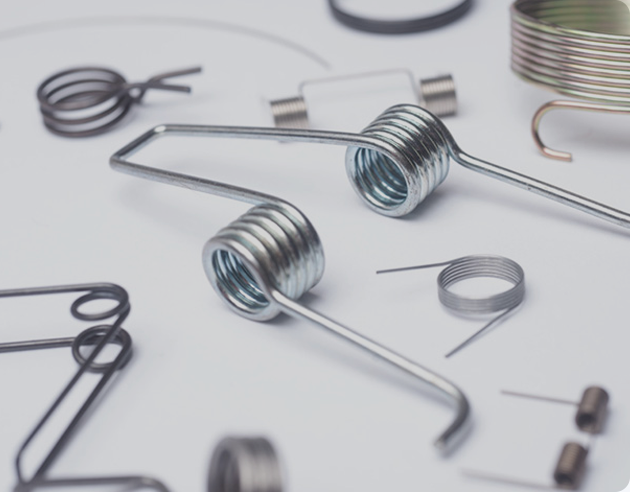
The wire diameter (d) has the strongest influence because it is raised to the fourth power. Doubling the wire diameter increases the spring rate by 2⁴ = 16 times. The mean coil diameter (D) is cubed, so doubling D reduces spring rate by a factor of 8 (1/8th the stiffness). The number of active coils (n) is linear: doubling the number of coils cuts the spring rate in half.
Example calculation: A spring with d = 2 mm, D = 15 mm, n = 8, G = 80,000 MPa. k = (80,000 × 2⁴) / (8 × 15³ × 8) = (80,000 × 16) / (8 × 3,375 × 8) = (1,280,000) / (216,000) = 5.93 N/mm. That means every 5.93 N of force (about 0.6 kg of weight) compresses the spring by 1 mm.
End types affect the number of active coils. A spring with closed and ground ends (most common for precision springs) has two inactive coils at each end, so active coils = total coils – Open ends (where the wire simply ends) have no inactive coils—all coils are active. For compression springs, closed ends prevent the spring from buckling sideways. For extension springs, loops or hooks at the ends are not counted as active coils.
What the spring rate does NOT depend on: The overall free length does not appear in the formula. Two springs with the same d, D, and n will have the same spring rate even if one spring is longer (for example, with a different pitch—the spacing between coils). However, the longer spring can compress further before coil bind (neighbouring coils touching). So, the spring rate is independent of free length, but the maximum travel (solid height) depends on wire diameter, number of coils, and pitch.
How do different spring materials compare in performance and corrosion resistance?
The choice of wire material determines the spring's maximum stress, temperature range, corrosion resistance, and cost. Here is a comparison of common materials for helical springs.
Music wire (ASTM A228, high carbon steel, 0.70–1.00% C). Tensile strength: 1,600–2,300 MPa depending on wire diameter (thinner wire has higher strength). Maximum operating temperature: 120°C. Corrosion resistance: poor (rusts readily). Best for: general-purpose springs in dry environments (toys, small mechanisms, ballpoint pens). Low cost. Fatigue life: moderate (10⁵–10⁶ cycles at moderate stress). Not for outdoor use.
Oil-tempered wire (ASTM A229, carbon steel). Tensile strength: 1,400–1,900 MPa. Temperature: 120°C. Corrosion: poor, similar to music wire. Best for: automotive suspension springs, heavy-duty industrial springs. Lower cost than alloy steel. Slightly less fatigue life than chrome-silicon.
Chrome-silicon steel (ASTM A401, 0.50–0.70% C, 0.60–0.90% Cr, 1.80–2.20% Si). Tensile strength: 1,700–2,100 MPa. Temperature: 220°C (higher than carbon steels). Corrosion: fair (better than carbon but still rusts). Best for: high-stress, high-cycle applications (engine valve springs, racing suspension). Excellent fatigue life (10⁷–10⁸ cycles). The silicon gives the steel resistance to permanent set (sag). More expensive than music wire by 30–50%.
Stainless steel (ASTM A313, types 302, 304, 316, 17-7 PH). Tensile strength: 1,200–1,800 MPa depending on type and temper. Temperature: 250°C for 302/304, 300°C for 17-7 PH. Corrosion: excellent (316 better for saltwater). Best for: medical devices, marine equipment, food processing, and outdoor furniture. Lower fatigue life than chrome-silicon (about 30–50% lower at the same stress). Type 316 has lower strength but higher corrosion resistance. Cost: 3–5 times higher than music wire.
Copper alloys (phosphor bronze, beryllium copper). Tensile strength: 600–1,300 MPa. Temperature: 150°C for phosphor bronze, 200°C for beryllium copper. Corrosion: excellent (phosphor bronze good for fresh water and mild chemicals; beryllium copper for saltwater and non-sparking tools). Best for: electrical contacts (conductive), corrosive environments where stainless steel is too stiff. Beryllium copper has high fatigue life but is expensive and toxic to manufacture (machining requires special ventilation). Phosphor bronze is cheaper but weaker.
What causes a helical spring to fail, and how can you detect a failing spring?
Helical springs fail primarily by three mechanisms: fatigue cracking, stress relaxation (sag), and corrosion fatigue. Each has distinct warning signs.
Fatigue cracking (most common in dynamic applications). A spring that cycles (compresses and releases repeatedly) eventually develops a crack at the point of highest stress—usually at the inner diameter of the coil, near the end where the wire bends. For an automotive suspension spring, the crack initiates after 10⁵–10⁶ cycles (about 3–5 years of driving). The crack grows 0.1–0.5 mm per 10,000 cycles. When the crack reaches 50–70% of the wire diameter, the spring will break suddenly. Warning signs before breakage: a change in spring rate (the spring feels softer), visible rust at a single location (cracks trap moisture), or a "twang" sound when the spring is compressed (the crack faces rubbing). For valve springs in an engine, a broken spring causes the valve to not close properly—symptoms include rough idle, backfiring, or misfiring. For mattress springs, a broken coil makes a popping sound when you sit on it.
Stress relaxation (sag, permanent set). When a spring is held compressed for a long time (e.g., a car stored for winter, a clamped mechanism), the internal stresses gradually reduce (relax) over time. The spring becomes shorter when unloaded. This is not a sudden failure—it's gradual. A car suspension spring that sags 10–15 mm (0.5–0.8 inches) over 10 years is normal. A sag of 30 mm or more indicates the spring was overloaded or overheated. Warning signs: the spring no longer returns to its original free length when unloaded. A mattress spring that has sagged causes a visible depression. You can test a small spring by measuring its free length with a calliper and comparing it to the original specification (usually 2–5% shorter after 10⁶ cycles is acceptable; 10–15% shorter means replacement).
Related products
If you are interested in our products, please consult us
CONTACT DETAIL
- Email: helispring@163.com
- Tel: +86-18767775615
- Address: Jinlu Industrial Zone, Beibaixiang Town, Yueqing, Wenzhou City, Zhejiang Province, China.
PRODUCTS
MOBILE TEMERNAL
Wenzhou Heli Spring Manufacturing Co., Ltd. ALL RIGHTS RESERVED.

China Customized Spring Manufacturer