

 English
 русский
 Español
Home / News / Industry News / Do complex wire forming spring configurations increase stress concentration at bending points
Do complex wire forming spring configurations increase stress concentration at bending points
Industry News-Complex geometries in wire-based elastic components are widely used in modern mechanical systems, especially in Configurations wire forming spring designs where clips, hooks, offsets, and multi-axis bends replace simple helical shapes. While these configurations improve functional integration, they also introduce a critical structural issue—localized stress concentration at bending regions.
Engineering studies on bent and formed wire elements consistently show that stress is no longer uniformly distributed once geometry deviates from simple circular or helical forms. Instead, curvature changes, torsional transitions, and multi-plane bends create high-stress zones that govern fatigue life and failure initiation.
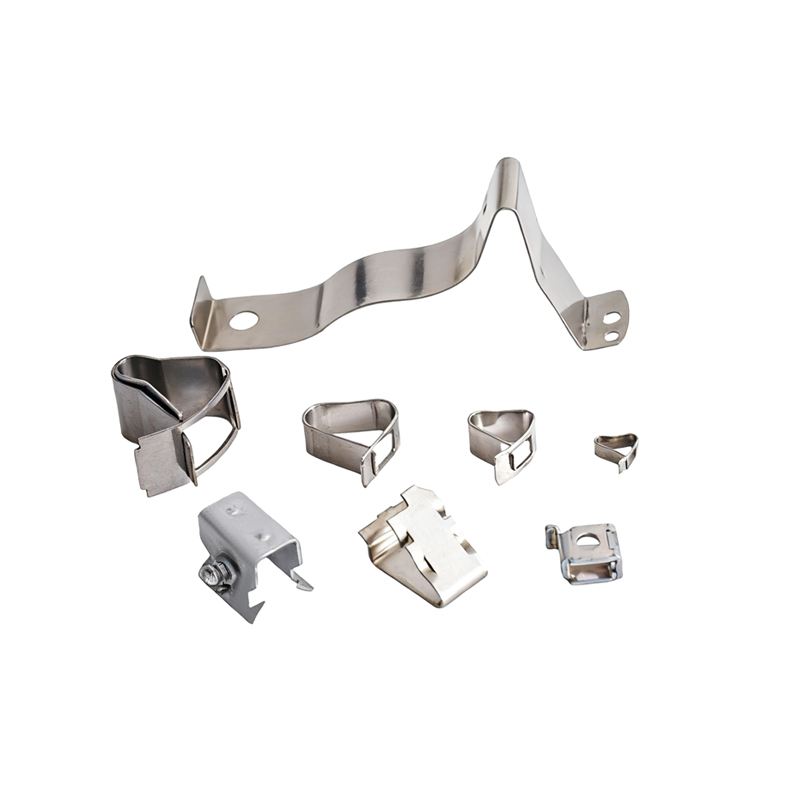
Stress Concentration in Wire Bending Regions
Why bending points become critical zones
During forming, straight wire is plastically deformed into curved shapes. Each bend forces material fibers on the inner radius into compression while outer fibers experience tension. This imbalance is the core reason stress concentration emerges.
- Inner radius compression: material is heavily compressed, reducing effective cross-section strength.
- Outer radius tension: tensile stress peaks at the outer fiber of the bend.
- Neutral axis shift: stress distribution becomes asymmetric under curvature.
Bending stress in wire springs can be approximated using curvature-adjusted formulations where correction factors account for amplified inner surface stress due to geometry effects.
Impact of Complex Geometry on Stress Distribution
From uniform helix to multi-bend wire forms
Simple helical springs distribute load relatively evenly along coil structure. Complex wire forming springs introduce multiple curvature transitions, each acting as a localized stress riser.
| Geometry type | Stress distribution behavior | Failure tendency |
| Simple helical coil | Uniform along wire length | Fatigue at coil inner surface |
| Single bend wire form | Localized peak at bend radius | Crack initiation at bend point |
| Multi-bend complex form | Multiple concentrated stress zones | Distributed but earlier fatigue onset |
Research on wire form springs indicates that irregular geometries require numerical methods such as spline-based modeling or finite element analysis to accurately capture stress behavior, since analytical formulas become insufficient for complex shapes.
Bending Radius and Stress Amplification
Small radius effects on local stress peaks
One of the more influential parameters in wire forming design is bending radius. Smaller radii significantly increase stress concentration factors, especially in high-cycle loading environments.
- Tight bends: amplify tensile stress at the outer fiber dramatically.
- Sharp transitions: introduce discontinuities in stress flow.
- Smooth curves: reduce peak stress by spreading deformation.
In mechanical forming studies, even slight reductions in bend radius can multiply local stress levels due to curvature-dependent stress correction factors commonly used in spring design calculations.
Multi-Axis Bending and Compound Stress States
Interaction between bending, torsion, and shear
Complex wire forming configurations rarely experience pure bending alone. Instead, combined loading states develop as wire segments are forced through multiple directional changes.
- Combined bending-torsion: wire twists while being bent, increasing equivalent stress.
- Shear coupling: cross-sectional shear adds to bending stress peaks.
- Residual stress stacking: forming process leaves internal stress locked in geometry.
Recent research on wire forming under composite loading conditions shows that different deformation sequences significantly alter stress evolution, confirming that stress concentration is highly dependent on forming path and geometry history.
Manufacturing Influence on Stress Concentration
Forming process vs final geometry behavior
Stress concentration is not only a design outcome but also a manufacturing artifact. Bending speed, tooling condition, and wire feed consistency all influence how stress is distributed in final parts.
- Tool wear: increases micro-variation in bend radius.
- Feed misalignment: introduces unintended torsion during bending.
- Springback effect: residual elastic recovery shifts final stress profile.
Wire forming machine studies show that inconsistent feeding and residual stress release during forming can introduce twist and uneven deformation, both of which increase localized stress concentration in final geometry.
Fatigue Behavior at Bending Points
Where failure typically begins
Even under moderate loads, repeated cycling causes fatigue cracks to initiate at high-stress regions. In complex wire forms, these regions are almost always located at bends or directional transitions.
- Outer bend radius under tensile peak stress
- Transition zones between multiple bends
- Clamping or constraint contact points
Once fatigue cracks initiate, propagation follows stress gradients, meaning sharp bends accelerate failure progression compared with smoother geometries.
Closing Technical Insight
Complex wire forming spring configurations inherently increase stress concentration at bending points due to curvature-induced stress imbalance, multi-axis loading interaction, and residual forming effects. While these designs provide functional versatility and compact integration, they also introduce multiple localized stress risers that govern fatigue life. Geometry refinement—especially bend radius control and smooth stress transitions—remains the primary strategy for reducing concentration severity in advanced wire form systems.
Related products
If you are interested in our products, please consult us
CONTACT DETAIL
- Email: helispring@163.com
- Tel: +86-18767775615
- Address: Jinlu Industrial Zone, Beibaixiang Town, Yueqing, Wenzhou City, Zhejiang Province, China.
PRODUCTS
MOBILE TEMERNAL
Wenzhou Heli Spring Manufacturing Co., Ltd. ALL RIGHTS RESERVED.

China Customized Spring Manufacturer