

 English
 русский
 Español
Home / News / Industry News / Carbon Steel Spiral Compression Springs: hidden risks of coil binding in tight-space designs
Carbon Steel Spiral Compression Springs: hidden risks of coil binding in tight-space designs
Industry News-Compact mechanical assemblies continue shrinking while load expectations rise. Within this constraint-driven environment, a Carbon Steel Spiral Compression Spring is widely adopted for its strength-to-cost balance, yet space-restricted layouts introduce a subtle failure mechanism often underestimated—coil binding.
Coil binding does not occur suddenly in many cases. It develops gradually through geometry mismatch, over-compression, and uneven stress distribution, eventually turning a stable spring into a restricted-motion element that loses functional elasticity.
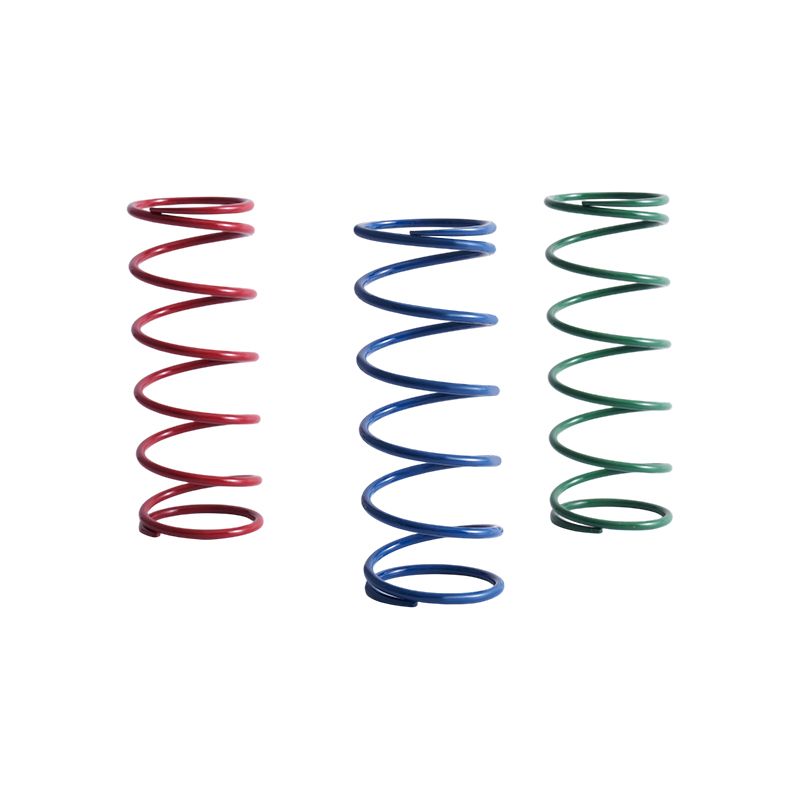
Space Restriction and Mechanical Interference
How tight housings influence spring behavior
Reduced installation clearance changes how coils interact during compression. In constrained cavities, the spring rarely operates with ideal axial alignment, increasing the probability of uneven coil contact.
- Axial misalignment: side contact appears earlier under load due to restricted guidance space.
- Uneven compression zones: coil pitch distortion concentrates stress at localized points.
- Reduced free travel: usable deflection range shrinks under geometric limitation.
Studies on helical spring design indicate that slender configurations with high length-to-diameter ratios are more vulnerable to instability effects, including lateral deflection and compression irregularity under load cycles.
Coil Binding Mechanism in Carbon Steel Spiral Compression Springs
From elastic compression to solid-height contact
Coil binding occurs once adjacent coils touch before the intended working stroke is completed. After contact, the spring behaves like a rigid rod rather than an energy-storing element.
- Solid height intrusion: operating load pushes coils into full contact earlier than designed.
- Load spike transfer: stress shifts suddenly to adjacent mechanical parts.
- Loss of compliance: elasticity drops sharply after coil-to-coil contact begins.
Design Parameters that Influence Coil Binding Risk
Geometry factors in confined assemblies
Spring performance in tight-space layouts depends on multiple interlinked variables. Small deviations in any of these can significantly increase binding probability.
| Parameter | Effect in tight-space design | Risk contribution |
| Coil pitch | Controls spacing between active coils | Low pitch increases early contact |
| Wire diameter | Defines stiffness and solid height | Thicker wire reduces available travel |
| Active coil count | Determines deflection range | Fewer coils raise stress per turn |
| Outer diameter | Influences housing clearance | Oversized coils may force lateral distortion |
Compression spring design principles highlight that solid height equals total coils multiplied by wire diameter, meaning even small changes in coil count directly affect available travel margin.
Stress Concentration Effects During Partial Binding
Transition from elastic to semi-rigid behavior
Before full coil binding occurs, localized stress peaks begin forming at coil contact edges. These peaks intensify fatigue progression and alter force distribution across the spring body.
- Edge loading: contact initiates at discrete points rather than uniform surfaces.
- Micro-deformation zones: repeated compression creates uneven plastic strain accumulation.
- Energy redistribution: stored elastic energy shifts abruptly during coil contact transitions.
Helical spring behavior studies show that improper load distribution increases localized stress and accelerates fatigue progression in coil regions subjected to repeated high strain cycles.
Role of Housing Constraints and Installation Geometry
Interaction between spring and cavity walls
Assembly design strongly influences whether a spring maintains linear compression or drifts into uneven deformation. Restricted cavities amplify frictional interaction between coils and surrounding surfaces.
- Wall contact friction: lateral rubbing alters compression symmetry.
- Guidance deficiency: absence of central rods increases buckling tendency.
- Thermal expansion limits: reduced clearance restricts dimensional tolerance under heat.
Common Coil Binding Scenarios in Real Assemblies
Where failure typically appears
- Miniature actuator systems with high stroke frequency
- Battery contact assemblies with restricted axial space
- Automotive sensor housings with shock-driven motion
- Compact valve return mechanisms under repetitive loading
Observable symptoms during operation
- Noticeable stiffness increase near end-of-travel
- Irregular rebound after compression release
- Audible clicking from coil contact
- Reduced effective stroke distance over time
Engineering Interpretation of Reliability in Tight Designs
Carbon steel spiral compression springs maintain strong mechanical resilience under standard operating envelopes, yet compact installations shift the design margin toward failure-sensitive conditions. Coil binding becomes less a material issue and more a geometry-driven constraint problem.
Design optimization typically focuses on balancing coil pitch, active length, and housing clearance rather than simply increasing material strength. Once binding begins, system behavior transitions from predictable elastic response to restricted mechanical movement, reducing overall functional stability.
Closing Technical Perspective
Space-limited assemblies redefine how compression springs behave under load. Carbon steel spiral compression springs remain structurally robust, but coil binding introduces a hidden limitation that emerges only through repeated operation cycles. Careful attention to geometry and working clearance becomes the deciding factor between stable energy storage and premature mechanical constraint.
Related products
If you are interested in our products, please consult us
CONTACT DETAIL
- Email: helispring@163.com
- Tel: +86-18767775615
- Address: Jinlu Industrial Zone, Beibaixiang Town, Yueqing, Wenzhou City, Zhejiang Province, China.
PRODUCTS
MOBILE TEMERNAL
Wenzhou Heli Spring Manufacturing Co., Ltd. ALL RIGHTS RESERVED.

China Customized Spring Manufacturer